Sunday, June 05, 2005
Americans Running for President
Two American citizens, Ebrahim Yazdi and Houshang AmirAhmadi have thrown their hats into the Presidential race in Iran among more than a myriad other candidates who registered their names for the position. And had about the same chance of approval of their applications as the low level factory guard, Abolghassem Khaki, from a remote desert town of Mehbod or Ebrahim Sarraf, (name means money changer) whose political platform rests on legalizing brothels. A political cynic quickly asked whether John Kerry had also decided to run in Iran.
The main hard-liner aspirants are as follows:
Former President Ali-Akbar Hashemi-Rafsanjani (recently “promoted” himself to
Ayatollah from his customary lower, Hojatoleslam clerical title)
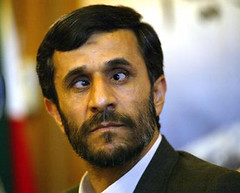
Tehran Mayor Mahmood Ahmadi-Nejad
Former National Police Chief Mohammad Bagher Ghalibaf
Former Head of the Revolutionary Guard Mohsein Rezai
Former National TV & Radio Chief Ali Larijani
Among the “reformers”:
Former Minister of Education Mostafa Moin (current President Mohammad Khatami’s ally).
Former Speaker of the Majliss (parliament) Mehdi Kahroobi
Khomeini’s Foreign Minister and now a” dissident” Ebrahim Yazdi
Prominent female dissident Aazam Taleghani (first female member of
parliament after the revolution)
In a replay of the last election for parliament (Majliss) where some 2000 candidates opposed to the Mullahs were forbidden to participate, out of about eleven hundred Presidential candidates, the unelected Guardian Council approved only six fervent Islamists until Supreme Leader Ali Khamnei realized that without any reformists in the running, he would be accused of discrimination or rigging the results and also lose a win/win gambit opportunity. On his orders Mostafa Moin received a nod as did an innocuous Director of National Sports.
The final selection indicates the following:
1) The ruling clerical factions have given in to the “be tough” military component of the regime that was at odds with any kind of softening of repressive Islamic regulations.
2) Desire not to muddy the waters with a larger and more confusing number of nominees for a disaffected populace.
3) Uncertainty of an adequate voter turn out and a wish to prevent dilution of the
votes for the winner.
4) The hope that allowing an active Reformist to run would increase voter turn out to their advantage since the Reformist would stand the chance of a snowflake in hell of winning.
89 women were the first to be axed. Ineligible – as women - to compete for this high a position because of gender. Interior Ministry spokesman Jahanbakhsh Khanjani complained that a loophole in the law permitted women like 18-year old Azam Ghaderi to put up her name as did ardent female dissident Aazam Taleghani.
While his grumble included other “wannabees”, a boy as young as sixteen (fifteen year olds are allowed to vote in Iran) and an 86-year old man, the comment confirmed the disgust of the increasingly dissident cleric – Ayatollah Montazeri - that “the people only have the freedom to choose from among candidates selected by the State”.
Originally a core member of the Revolution with Khomeini, Montazeri was slated to succeed him but was passed over at the last minute in a power struggle that brought in Ali Khamnei to fill Khomeini’s shoes.
Montazeri reiterated that power in Iran rests with the unelected Supreme Ruler and not with the people so he expects very few will turn out to vote. A Persian saying goes: “he spoke to the door so the wall would hear” – offering an oblique instruction to his followers and anyone else who might care to listen, to boycott this election.
At the opposite end of the political spectrum, heir to the Persian throne, Reza Pahlavi has begun openly encouraging a boycott of the elections without fielding a practical alternative political structure at this time. Except by inference that a return to the monarchy might suit the people well.
The 800 pound gorilla in the race, former President Rafsanjani, who placed thirtieth when he previously competed for a parliamentary seat in 2000, barely made the cut for a run off and backed out of the election to save face. He now wants a third (non-consecutive) term as President.
Those in the loop realize the 73-year old pragmatist hardliner, known to some as the Eunuch for insufficient facial hair and to others as the Shark for the same smooth feature and predatory financial activity - best illustrated by the feeding frenzy of the marine denizen - has entered the contest for simple survival rather than a desire to hold high position. The presidency brings a modicum of immunity.
The hardliners encouraged to run against him by arch rival Supreme Ruler (unelected) so-called “Ayatollah” Ali Khamnei, have every intention of putting an end to Rafsanjani’s stated intentions of renewing ties to America and implementing changes in foreign relations. Probably by impeaching him on financial corruption and even trying to get him imprisoned and if possible hanged as a traitor, something even his enormous influence might not be able to prevent.
The universally accepted, real Ayatollah, Shariat-Madari , now dead, warned at the time of the revolution, power should not be given to “us clerics” (akhoond), who will bicker and fight over it and have no idea how to run a modern country, so will ruin it.
Hojatoleslam (title a notch below Ayatollah) Reza Hassani, strong supporter of and spokesman for Supreme Ruler Ali Khamnei (whose title of Ayatollah was recently – quite factually - dropped on the most prominent local Iranian television in America when referring to Khamnei) stated: “elect Rafsanjani and we will have the atomic bomb”. Khamnei’s duplicitous support of Rafsanjani through his surrogate indicates an attempt to drive hesitation into any Western support that might lean in that direction.
Rafsanjani’s attempt to cloak himself in some vestige of Reformist ideals and vague hints of relaxing the Islamic regime’s hard-line internal and foreign policies flies in the face of his masterminding some 100 assassinations of credible Iranian opponents or dissidents around Europe when he had the post of President the last time around from 1989 – 1997. His network of paid agents spreads from Australia to Europe and to the USA. Specially to Canada where he also has multi-billion dollar real estate developments. Using vast bank accounts hidden in off-shore banks he pays agents in virtually every major city to promote him or to attack and often to do away with opposition.
Born in the Eastern Iranian province of Kerman in 1934 to a family who lived just above poverty from the sale of pistachio nuts from their stand of trees, Rafsanjani must have decided he would never want for anything again and has become a self-made billionaire gracing the cover of Forbes magazine but claiming extreme poverty. At the age of about 14 he studied Islam under Khomeini, which provided him ties to the 1979 Revolution, propelling him to Speaker of Parliament in 1980 and a key role in the war against Iraq. Surviving a bomb attack in 1981 he negotiated the arms for hostage deal with the USA in 1985.
By 1988 he concludes a UN assisted ceasefire agreement with Iraq but 17-years after the fact, no formal peace treaty has been signed between the two countries, leaving open the door for Iran to “resume war” at will. By 1989 he wins election as President and re-election in 1993 till 1997 when term limits prohibited a third term. An attempt in 2000 to become a member of parliament failed shamefully.
Rafsanjani’s influence is legend but so are some amusing rebuffs. A couple of years ago a relative asked him a favor to grant a lady a bread bakery license on the southern Island of Kish in the Persian Gulf, which should theoretically be a monopolistic goldmine. Unable to refuse his recommendation, local Kish authorities granted the license but made sure that the woman was totally unable to obtain or bring in flour with which to bake the bread.
Hojatoleslam Hassani’s “support” of Rafsanjani at a Friday prayer sermon in West Azarbaijan also included the comment that “Islam always spoke with sword in hand. Why should we change now?”
One of the candidates, hardliner Mohammad Bagher Ghalibaf, Chief of National Police till last April (resigned the post to be allowed to run for President) and a former Commander of the Revolutionary Guard Air Force has strong anti-civilian characteristics and was one of the two dozen Revolutionary Guard commanders to warn outgoing “reformist” President Khatami in July of 1999 that if he did not enforce hard-line morality in society, the military would take over those duties.
The impending militarization of the Presidency and later likely Cabinet choices to go to the other candidates like Ghalibaf, former Guard Commander Mohsein Rezai, former Head of National TV and Radio and erstwhile Guard member Ali Larijani and military backed Tehran Mayor Mahmoud Ahmadinejad, should any of these be elected President, would find most if not all of them in top positions, culminating in a military minded, very tough stance, take over similar to that of Nazi Germany by Hitler.
Ghalibaf, like most of them, seeks to garner support of young Islamist conservatives by stating he wants everyone serving in his future government to be younger than he is.
His brother - a notorious and never arrested, large scale, drug smuggler and distributor - has helped lure Iran’s youth of all persuasions into addiction in vast numbers. A significant portion of Iran’s youth, facing mind and body sapping daily stress, have become addicts, with easily imagined adverse social repercussions. Remember, 46 million out of population of 69 million – about two thirds – are under the age of thirty. They remember little or nothing prior to the Mullahs.
Countless employed workers, paid too little too live on, search through garbage to find food they cannot afford to buy to feed their families. Orphaned or abandoned street kids by the tens of thousands in the capital Tehran and to a great extent in provincial cities beg and sell themselves for food - forget shelter from freezing winters and searing summers - with nowhere to reach out to or anyone in government to help them.
Except those who cull the pretty boys and girls off the streets and sell them to brothels in the Persian Gulf and elsewhere. Or place them in secret local brothels operated by those close to and protected by the regime. An involved electorate cannot arise from all this. Nor a strong political opposition.
The Chinese were accused at one time of supplying cheap black tar heroin to the USA market with the sole intent of getting our citizens addicted and weakening the structure of our society. The Mullahs have achieved the same ends by default and ineptness.
Semi-reformist candidate, in name at least, former parliamentary Speaker and cleric, Hojatolslam Mehdi Kahroubi has recently leaked secrets about his opponents but few about his own multiple misdeeds and obstruction of reforms or the sources of huge funding being sent in his direction. He has a foot in both camps and was never an effective leader of parliament, gaining his position when the Guardian Council refused to accredit anyone suggested by current President Khatami.
Kahroubi’s ambitions were nearly ended recently when the provincial balcony from which he and his supporters were campaigning collapsed, leaving them all in a heap of rubble below. He escaped unhurt.
Two Reformist candidates, first banned then approved within 48-hours, on the say-so of Supreme Ruler Ali Khamnei (so easily confused in name with ineffective, outgoing “reformer” President Mohammad Khatami), were finally allowed to run in a cat and mouse game initiated by the Supreme Ruler.
His orders to approve former Education Minister Moin and the token back up reformist alternative, the National Sports Director, as presidential candidates gives him the option of declaring the Reformists had always intended to avoid campaigning and turning out the vote if they refused to run after being cleared. Or to have them run vigorously and lose badly in the rigged environment, thus proving the people did not want reforms.
Catch 22 for Moin, an ally of outgoing President Khatami, in accepting to campaign seriously, which he appears to have adopted as his policy, he will have to promise the moon and the skies to get elected. Khatami, who added the sun as well in the past, getting a huge part of the electorate to vote him into office eight years ago, proved powerless to enact anything and became the figure head and stalking horse of “virtual democracy” inside which the Islamic regime hid when negotiating with the rest of the world.
The former teacher can only use this opportunity – since his participation has been approved – to speak out against the theocracy in a manner that would have had him immediately arrested without this political cover. Though nothing ensures arrest, imprisonment and life threatening abuse may not take place for him after the elections.
Moin cannot implement any promise he makes as long as the unelected Supreme Ruler and his 12-man unelected Council of Guardians or the powerful Expediency Council, headed by opponent Rafsanjani (also not favorably inclined to Moin) which resolves disputes between the clerical establishment and parliament, veto or block anything they dislike. The Councils, to which can be added the Assembly of Experts, layered above the Presidency, make his life – if elected - more than difficult.
While campaigning in the provinces with President Khatami’s brother, leader of the major reform party supporting Moin, both were attacked by militant hard-line thugs and had to be rescued by local police authorities. Who would not have reacted had the attacked persons not been so prominent.
The Presidency in Islamic Iran has no power to implement anything when the Constitution itself has been interpreted and implemented to bias matters in favor of the real power, an unelected Supreme Ruler, who is selected by the Assembly of Experts. Any glimmer of legitimacy disappears when the following power structure of the unelected Ruler gets clarified:
The Assembly selects the leader but cannot dismiss him. The 12-member Guardian Council, which has the authority (by their own interpretation) of validating or vetoing candidates for any position – including for member of the Assembly of Experts - consist of six clerical jurists and six lawyers appointed by the head of the Judiciary. No ray of sunshine here either as the Head of the Judiciary serves by appointment of the Supreme Ruler. Thus all 12-members of the omnipotent Guardian Council are appointed either directly by the Supreme Ruler or by his subordinates and obey him.
The Judiciary, headed by the Supreme Ruler’s choice, also reports to nobody but him. “Independent”, certainly, but not responsible to an electorate or elective process. Even the Guardian Council membership that must be “approved” by Parliament receives votes from a pre-stacked deck, chosen by their pre-selected candidates.
This scenario makes matters virtually impossible for Moin legislatively. The last elections for members of the Majliss (parliament) packed it with terrorist minded members or their supporters. For example over thirty of the “approved” candidates for Majliss from Tehran ran under the aegis of the Developers of an Islamic Iran (Abadehgaran-e Iran-e Eslami), who initially backed former National TV Chief Ali Larijani’s run for presidential position (not power) because of a slice of military backing he enjoyed, but now appear to have retreated to not backing anyone specific – as long as the candidate is a hard-line Islamist.
A few examples of some of those previously supported by the Developers of an Islamic Iran for member of parliament provides an insight into their philosophy, though in recent years they seem to prefer to be an Eminence Grise and operate in the background without betting on or fielding particular candidates or personalities:
Parviz Sourouri, a top Basij (para-military, vigilante force) organizer in part of the capital of Tehran, also has the duties of editor-in-chief of Revolutionary Guard Pasdaran) publications in Lebanon and Syria and an activist favoring and encouraging terrorism.
Said Abu Taleb, a Pasdaran (Revolutionary Guard) intelligence and security member - was active in Iraq, was arrested posing as a TV employee and later released.
Hossein Fadai, an organizer of the military “special forces” group known as the Badr forces that undertake terrorist activity in Iraq and oversee supplies to the Iranian armed forces.
M. Kuchekzad, responsible for organizing safe houses for Iranian terrorists and intelligence personnel in Karbala, Iraq and a listed terrorist himself.
Elias Naderan, manages Pasdaran legal matters in parliament.
Alireza Zaakni, in charge of Basij (para-military) presence among students and inside Tehran University and oversees Basij/student activity nationwide as a suppressive measure to prevent freedom movements or demonstrations. Openly contravenes law which forbids law enforcement personnel on University campuses.
Emad Afrough, member of the Governing Council and in charge of security and intelligence matters in the Guardian Council.
Seyed Fazlollah Moussavi, Director for the Committee for the defense of the Palestinian Nation and head of the council looking after the benefits paid to the Martyrs of the Intifada (largely considered a terrorist group by supplying suicide bombers).
Not surprisingly, neither of the two American candidates for President of Iran has been qualified to participate by the Guardian Council, though Iran wants to set up polling booths throughout America so that Iranians in the USA can vote and depending on how many pro-Islamic regime residents or denizens can be found here, try to increase final voter turnout statistics.
Possibly providing a golden opportunity, should permission be granted, for Homeland Security to monitor and discover such pro-Iranian regime voters and by inference anti-America (the Great Satan) activists hidden among us. Would national security discovery override any claims to invasion of privacy?
The least credible and opportunistic American candidate, Houshang AmirAhmadi, was described by those who knew him as basically a nobody back home in Iran before the revolution with socialistic tendencies and has since his arrival in the USA pretended to be neutral in his efforts to promote the Mullah’s causes in America. In his own words he “sees no reason for the Iranian Islamic regime, to disqualify me and not let me run”. When taken in context of the Guardian Council prerequisites of a candidate already being a statesman and highly qualified religiously, the comment sounds as vain as it is.
AmirAhmadi’s critics accuse him of allegedly plagiarizing material from students and others in his teaching position at Rutgers University and aligning himself with a powerful oil group to use his contacts in the Islamic regime to deal in prohibited Iranian oil and exploration, thus serving his self-gratification instead of either Islamic or Western principles. At least he appears not to have caused death and cruel misery of Iranians as has the other American candidate Ebrahim Yazdi.
In brief, Yazdi, an American trained geneticist, who taught at Baylor University in Texas, joined the founder of the current Islamic regime, “Ayatollah” Rouhollah Khomeini in his French exile after Saddam Hussein of Iraq threw Khomeini out of Iraq (already exiled from Iran). Later he became Deputy Prime Minister for Revolutionary Affairs in Prime Minister Mehdi Bazargan’s secular provisional government set up by Khomeini, who abolished it after a short nine months to put in place an Islamic clerical regime and constitution.
He also held the position of Prosecutor General resulting in criminal charges being filed against him in Britain by 38 Iranian Human Rights advocates inside Iran and 27 outside those borders.
In the filing Yazdi has been summarized as having trained in Yasser Arafat’s terrorist camps in Lebanon prior to 1979 and as the architect and founder of the now notorious Revolutionary Guard and spearhead of the post Revolution kangaroo courts. These lawless courts gave official imprimatur to the bloodbath Khomeini and his minions like Yazdi let loose immediately after their take over.
When Khomeini was asked in very early days what should be done to reorganize the Ministry of Justice, he replied: “anyone who is against me is against God and should be killed immediately on the spot as waging war against Allah. We do not need any other justice”. Yazdi was happy to oblige this mind set.
He held and enjoyed televised interrogations of principal military and civilian leaders of the Shah’s monarchy like Prime Minister Abbas Hoveyda, Police Chief General Mehdi Rahimi, Security Chief General Nematollah Nassiri, Army Air Wing commander General Manouchehr Khosrowdad, and paraded them, often bleeding and hurt, while taunting, threatening and humiliating them with instructions to confess their sins, all for Iran’s television viewers – and to strike widespread fear into anyone not immediately joining the Islamic take over.
Reminiscent of the public belittling and guillotine execution by the mobs of aristocrats and nobility in the French Revolution (some centuries ago).
Or perhaps merciless Jesuit torture and demand for repentance in an even longer distant past, where a confession, given without prior torture, was unacceptable and invalid. Yazdi adopted a similar mind set in the name of the sacred Koran, which fervent Sunnis believe has existed as long as has Allah and was written in Arabic, which is the language Allah speaks –and has always spoken. Thus translation of the Koran into other languages cannot be permitted and blasphemes.
Yazdi, now a self-proclaimed dissident against the regime he helped establish, wants to be President of Iran, triggering the thought of “out of the clerical frying pan into his secular fire”.
With one candidate as bad- or worse than the next, or impotent to enact change if elected, the movement to boycott the elections as a show of protest has gathered momentum among the nearly 40 University Student Associations.
Unfortunately, infiltration of the para-military Basij vigilantes into student groups, the readiness of the Mullah regime to kill, maim or imprison at the drop of a hat has resulted in a lack of leadership among these, including the most active one called the Strengthening of Unity (Tahkeem-e Vahdat).
With only about 1.2 million university students, among a 69 million population in Iran, (49 million eligible to vote) hopes in Western governments to use them as a tool to overthrow the Mullahs appear to thin in the face of what they are expected to remove and the hardships they face. Including their being divided into factions, with some wanting to withdraw from the political system and advocating a boycott, while ever hopeful others like the Shiraz faction still cling to operating within the system to achieve change.
One major hope exists that the combination of the students and increasingly disenchanted Bazaar merchants may have enough strength to drive the Mullahs out. Beginning with a growing Bazaar support of a boycott.
A similar co-operation between the Bazaar merchants and the clerics was largely responsible for the arrival and growth of the current Islamic regime. While innately conservative and religious, the powerful merchants turned against the Shah after he moved the center of financial power from their kiosks in the old town Bazaar, that had a strangle hold on 90% of the country’s imports, to a more modern economical multi-national structure in uptown Tehran. These merchants now hark on the poverty and misery Rafsanjani brought last time he was President.
Strongly motivated by money, these merchants blame him for free market (privatization) reforms that in their minds brought about staggering inflation, unemployment close to the 50% range if we consider employed but unpaid, widespread drug addiction and a Carter like misery index that they do not want increased by another Rafsanjani term.
One US Dollar used to cost a mere 79 Iranian Rials, even at street level, during the monarchy. Having to pay over 9000 Rials today for the same dollar provides an indicator of the economical change being faced by these traditional merchants.
The Bazaaris also resent the spate of millionaire Mullahs (billionaire in the case of Rafsanjani, who comes from modest origins of a small pistachio orchard family), who have taken over the most lucrative businesses: banking, hotels, automobile and chemical companies, drugs (both legitimate and unlawful kinds) and consumer goods.
Perhaps among the most lucrative entities available to the clerics but not the merchants are the Islamic charities that received these businesses after confiscation from the former owners after the Shah left and now act as slush funds for the Mullahs with which to make more money. They compete with the interests of the Bazaar just as the Shah’s actions did in modernizing commerce within the economy to unlock astronomical capital squirreled away in safes or stacked in roomfuls of property deeds in the Bazaar and unavailable to finance development of the country.
The greatest obstacle to removing the Mullahs lies not in elections but in the lack of any available charismatic or acceptable leader to rally the populace. Although within Iran a growing call for the return of the Monarchy has reached a strong undertow level among those who still remember it – most were born after it was gone.
The dauphin Reza Pahlavi and the monarchists face a daunting challenge of having to spill enormous amounts of Mullah blood to regain control of Iran. Something which would come back to haunt him and his followers in future democratic politics, as opposed to everyone knowing he was too young to be accused of being a part of anything his father did that could be termed a negative.
The only Quixotic national figure in Iran, that many would follow, is their version of South Africa’s Mandela, the 72-year old Abbas Amir Entezam, who was Deputy Prime Minister and Spokesman for the Interim Revolutionary government of Mehdi Bazargan but having been accused by the Islamic regime which followed under a year later as being a CIA agent, he has spent decades in prison or under house arrest.
Throughout all of which he has refused to compromise his principles despite torture and illness and thus earned the respect of most Iranians. Sadly, perhaps, his gentle, liberal philosophy would prevent him from effectively changing or handling the change after the removal of the Mullahs in any which way.
The conundrum of how to deal with a potentially nuclear Iran and its entrenched cesspool of constitutionally protected equivalent of old Europe’s robber barons of the Dark or Middle ages has left the usually selfishly forgiving of the Mullahs, by European negotiators with a wait and see attitude till after the June 17th elections. Privately they admit to low expectations of any significant change for the better from the newly “elected” President and his Cabinet of hard-liners, specially with their tough minded military background. While they procrastinate Iran proceeds with intense efforts to obtain a nuclear bomb.
The Bush administration, intent on passing difficult legislation relating to Social Security and Tax Reforms, before a lame duck status really kicks in, seems content to put international challenges on a back burner till they are ready or have achieved domestic priorities.
The West continually fails to understand or give weight to the fact that in trying to change the actions of the Mullahs they do not factor in that a leopard cannot change its spots and that Khomeini’s brand of Islam is not a religion but an admitted socio-political and economical ideology no different from National Socialism, Communism or any other “ism”. Including terrorism, a constant staple of Islamo-Fascism in efforts to take over the world and impose their views – by the sword if necessary – in the name of Allah. Also true for the Wahabi Saudis or the North African Salafists.
Christianity has had its own historical periods of doing the same but in the modern world, proselytizes, vigorously at times, rather than killing or physical torture to achieve its ends as does Islamic fervor.
Elections of any description in Iran will not resolve much – if anything. So what can be done to prevent Iran, already with of all the components of a nuclear weapon on hand, from becoming the world’s worst nightmare and virtually unstoppable in the near future? Reports indicate that Iran already has at least two Soviet era nuclear bombs in their arsenal and appear to be close to viable delivery systems. They recently announced solid rocket fuel capability and a 2,000 kilometer target range.
Some brief considerations:
Using the current electoral or political process available in Iran may take half a century or more – if at all - to bring freedom to the people and essential change of Iran’s mindset to sustain or promote future global peace. Too late for practical purposes.
Changing the Islamic constitution by referendum, while a logical thesis, may be impossible prior to removal of the clerics since they will resist, impede and prevent such an event. Usually by brutal means.
A military attack to destroy the nuclear sites, many of them still unknown will have immediate consequences, including if nuclear bombs are used, with a Hiroshima philosophy, for this purpose:
a) a justification for Iran to then claim the need for the nukes for self-defense or to lambaste whoever attacked them, specially with a nuclear technology
b) an all out attack on Coalition forces in Iraq by some 250,000 Revolutionary Guards currently on the Iran-Iraq border poised for intervention against the US or coalition.
c) Other high level but soft target attacks on US and Allied interests around the world. The Mullahs, who would have no future in Iran without present power, will not give up without a desperate fight and kill as many as they can to prevent a take over.
NOTE: They mostly use foreign mercenaries – not Iranians – to quell dissent or street demonstrations. Yemenis, Saudis, Palestinians, Syrians, Afghan Taliban, Algerians, Iraqis, various nationality Al Qaeda members, etc., so their strike forces have no reluctance to kill and cannot be dissuaded or persuaded to cease and desist by incoming political leadership.
The idea that Revolutionary Guards might side with new leadership and risk their own future punishment for misdeeds during the Islamic Regime, despite all offers of amnesty, appears unreal. Specially when civilians who suffered at their hands demand and insist on retribution. Thus, though some might not actively resist, no major support can be expected.
Applying the general concept used for a government overthrow in Ukraine, without extremely specific tailoring to suit Iranian deep down mindsets, social conditions, economical factors, psychological waft and weave of the population and the Mullahs themselves, harsher suppression methods than existed in Ukraine and a multitude of factors that differentiate the two situations, invites dismal failure and a loss of many civilian lives for little gain.
To successfully wrench control from the Mullahs – short and long term - will require almost eradicating them – both to regain manageable daily governance and to avoid later constant plots and internal terrorism against the new leadership and regime of whatever type or denomination.
None of the internal or external opposition groups vying to take over from the Mullahs – except one – has either the resolve or the ability – mental or in a force of arms – to conduct such bloody warfare and go up against the numerous, ruthless mercenaries called to action from their barracks around the country or fervent Revolutionary Guards and a host of other Islamic paramilitary units that exist independently in Iran.
The one group that has the will and the means and an activist following, the Mojaheddin-e Khalgh have been taken off the table – for now - and labeled a terrorist group by the US State Department and some European countries.
Using the Mojaheddin (MEK) needs very careful consideration as would the surgical tools in a medical operating room or poisonous ingredients for life saving medications.
Khomeini reportedly had British Parentage
Proponents for using the MEK as a way to remove – sandblast – the Mullahs from power and then clear the deck of the MEK itself in follow up action – similar to sweeping away the sand blast pellets afterward, consider this the only quick and practical, pragmatic way to institute successful regime change within a short period of time.
Continued talks and diplomacy with Iran, as championed by Europe, only provides a contemporary version of what Europe did with Hitler. Repeatedly accepting the unacceptable from the Mullahs, as has been the case, resembles Hitler’s invasion of other countries without anything but verbal reaction. Somebody finally had the resolve to put a stop to it or we might be speaking German here in America.
In the simplest of terms, you unofficially unleash the MEK, provide extensive financial support without acknowledging them formally, remembering that financing by all sources in peaceful Ukraine, including from Soros, to make the changes ran into the $100 million mark, then allow them to do what needs be done. Possibly also providing tactical military air support for their initial attacks and a defacto back up ostensibly through a political front inside Iran which allies itself in the effort but does not carry the baggage of the MEK .
Some givens include an active MEK following of around 100,000 persons inside Iran. Enough to help get the job done but not enough to retain power politically or by force against the wishes of the population, which generally holds the MEK in disfavor.
Another, their Marxist views will prevent them from growing deep roots inside the Iranian populace, despite an initial honeymoon period and their long established efforts to use Islam for recruitment.
The necessary shedding of clerical blood – which the MEK will do eagerly in revenge for the barbaric treatment they received at the hands of the Mullahs in the 80’s, also labels them for the future as “murderers”, who can be accused of violations and allow a now at peace Iranian population to vote them out or to remove them as a “criminal element”. More likely to rise up and overthrow them within a projected time span of two or three years. Left behind would be a clean, sandblasted field for more normal democratic political systems and constitutions.
Propaganda by the West to remove the MEK later can be easily justified by their former terrorist status and appellation. Not being stupid, the MEK will naturally have considered all this in advance and will make demands for assurances, which can mostly be evaded by the major powers. However, given the opportunity, they will jump at the idea of a chance to take over Iran.
Their leadership has already been promoting such an action and the removal of their “terrorist” classification. Official MEK leader, Mariam Rajavi, who together with her husband Massoud, rule the organization has proposed the West support the MEK in a take over of the country and by allowing them six months to govern Iran without a constitution before holding free and open elections.
The first fly in the ointment might be that President Vladimir Putin of Russia may quite possibly become an ardent supporter of the MEK once they are in power and block efforts to remove them.
The second obstacle stems from the fact that the MEK has strayed far from a political organization into that of a hardnosed cult that demands virtual worship of the leadership by all and sundry and meted out beatings, death, torture and years of solitary confinement to anyone who wished to leave.
Precise, detailed report- Human Rights Watch investigation titled “No Exit” – a 29-page downloadable PDF file at http://hrw.org/backgrounder/mena/iran0505/.
The viability of the MEK also know by other names, including MKO, as a surgical tool or sandblast machine becomes apparent in the brief history of the MEK at the naval website: http://library.nps.navy.mil/home/tgp/mek.htm . That text shown below for quick reference in case the reader does not have immediate Internet access:
Mujahedin-e Khalq Organization (MEK)
From: Country Reports on Terrorism, 2004. United States Department of State, April 2005.
Other NamesThe National Liberation Army of IranThe People's Mujahedin of Iran (PMOI)National Council of Resistance (NCR)National Council of Resistance of Iran (NCRI)Muslim Iranian Student's Society
DescriptionThe MEK philosophy mixes Marxism and Islam. Formed in the 1960s, the organization was expelled from Iran after the Islamic Revolution in 1979, and its primary support came from the former Iraqi regime of Saddam Hussein starting in the late 1980s. The MEK conducted anti-West-ern attacks prior to the Islamic Revolution. Since then, it has conducted terrorist attacks against the interests of the clerical regime in Iran and abroad. The MEK advocates the overthrow of the Iranian regime and its replacement with the group’s own leadership.
ActivitiesThe group’s worldwide campaign against the Iranian Government stresses propaganda and occasionally uses terrorism. During the 1970s, the MEK killed US military personnel and US civilians working on defense projects in Tehran and supported the takeover in 1979 of the US Embassy in Tehran. In 1981, the MEK detonated bombs in the head office of the Islamic Republic Party and the Premier’s office, killing some 70 high-ranking Iranian officials, including Chief Justice Ayatollah Mohammad Beheshti, President Mohammad-Ali Rajaei, and Premier Mohammad-Javad Bahonar. Near the end of the 19801988 war with Iran, Baghdad armed the MEK with military equipment and sent it into action against Iranian forces. In 1991, the MEK assisted the Government of Iraq in suppressing the Shia and Kurdish uprisings in southern Iraq and the Kurdish uprisings in the north. In April 1992, the MEK conducted near-simultaneous attacks on Iranian embassies and installations in 13 countries, demonstrating the group’s ability to mount large-scale operations overseas. In April 1999, the MEK targeted key military officers and assassinated the deputy chief of the Iranian Armed Forces General Staff. In April 2000, the MEK attempted to assassinate the commander of the Nasr Headquarters, Tehran’s interagency board responsible for coordinating policies on Iraq. The normal pace of anti-Iranian operations increased during "Operation Great Bahman" in February 2000, when the group launched a dozen attacks against Iran. One of those attacks included a mortar attack against the leadership complex in Tehran that housed the offices of the Supreme Leader and the President. In 2000 and 2001, the MEK was involved regularly in mortar attacks and hit-and-run raids on Iranian military and law enforcement units and Government buildings near the Iran-Iraq border, although MEK terrorism in Iran declined toward the end of 2001. After Coalition aircraft bombed MEK bases at the outset of Operation Iraqi Freedom, the MEK leadership ordered its members not to resist Coalition forces, and a formal cease-fire arrangement was reached in May 2003.
StrengthOver 3,000 MEK members are currently confined to Camp Ashraf, the MEK’s main compound north of Baghdad, where they remain under the Geneva Convention’s "protected person" status and Coalition control. As a condition of the cease-fire agreement, the group relinquished its weapons, including tanks, armored vehicles, and heavy artillery. A significant number of MEK personnel have "defected" from the Ashraf group, and several dozen of them have been voluntarily repatriated to Iran.
Location/Area of OperationIn the 1980s, the MEK’s leaders were forced by Iranian security forces to flee to France. On resettling in Iraq in 1987, almost all of its armed units were stationed in fortified bases near the border with Iran. Since Operation Iraqi Freedom, the bulk of the group is limited to Camp Ashraf, although an overseas support structure remains with associates and supporters scattered throughout Europe and North America.
External AidBefore Operation Iraqi Freedom, the group received all of its military assistance, and most of its financial support, from the former Iraqi regime. The MEK also has used front organizations to solicit contributions from expatriate Iranian communities.
NOTE: the MEK also solicited money from travelers at major airports around the country, using volunteers or hired affiliates to gather funds and receive a daily commission themselves. Vans would pick them up and drop them from designated points or offices rented for this purpose.
Meanwhile, in Iran, Supreme Ruler Khamnei’s desperate last stab at a high turn out was to declare “voting is as important as praying!” and “a vote in the ballot box is a bullet in the heart of George Bush”.


Thursday, May 05, 2005
Gruesome video of Islam, "Religion of Peace" in action in Iran.
Equal Opportunity Killers - men and women alike .
Not for the faint of heart.
Language spoken in the background is Persian Farsi.
Click here.
Monday, March 15, 2004
Jimmy Carter's Illegal Demands on Shah
Strong intelligence has begun to emerge that US President Jimmy Carter attempted to demand financial favors for his political friends from the Shah of Iran. The rejection of this demand by the Shah could well have led to Pres. Carter’s resolve to remove the Iranian Emperor from office. 1 GIS.
The linkage between the destruction of the Shah’s Government — directly attributable to Carter’s actions — and the Iran-Iraq war which cost millions of dead and injured on both sides, and to the subsequent rise of radical Islamist terrorism makes the new information of considerable significance.
Pres. Carter’s anti-Shah feelings appeared to have ignited after he sent a group of several of his friends from his home state, Georgia, to Tehran with an audience arranged with His Majesty directly by the Oval Office and in Carter’s name. At this meeting, as reported by Prime Minister Amir Abbas Hoveyda to some confidantes, these businessmen told the Shah that Pres. Carter wanted a contract. previously awarded to Brown & Root to build a huge port complex at Bandar Mahshahr, to be cancelled and as a personal favor to him to be awarded to the visiting group at 10 percent above the cost quoted by Brown & Root.
The group would then charge the 10 percent as a management fee and supervise the project for Iran, passing the actual construction work back to Brown & Root for implementation, as previously awarded. They insisted that without their management the project would face untold difficulties at the US end and that Pres. Carter was “trying to be helpful”. They told the Shah that in these perilous political times, he should appreciate the favor which Pres. Carter was doing him.
According to Prime Minister Hoveyda, the Georgia visitors left a stunned monarch and his bewildered Prime Minister speechless, other than to later comment among close confidantes about the hypocrisy of the US President, who talked glibly of God and religion but practiced blackmail and extortion through his emissaries.
The multi-billion dollar Bandar Mahshahr project would have made 10 percent “management fee” a huge sum to give away to Pres. Carter’s friends as a favor for unnecessary services. The Shah politely declined the “personal” management request which had been passed on to him. The refusal appeared to earn the Shah the determination of Carter to remove him from office.
Carter subsequently refused to allow tear gas and rubber bullets to be exported to Iran when anti-Shah rioting broke out, nor to allow water cannon vehicles to reach Iran to control such outbreaks, generally instigated out of the Soviet Embassy in Tehran. There was speculation in some Iranian quarters — as well as in some US minds — at the time and later that Carter’s actions were the result of either close ties to, or empathy for, the Soviet Union, which was anxious to break out of the longstanding US-led strategic containment of the USSR, which had prevented the Soviets from reaching the warm waters of the Indian Ocean.
Sensing that Iran’s exports could be blocked by a couple of ships sunk in the Persian Gulf shipping lanes, the Shah planned a port which would have the capacity to handle virtually all of Iran’s sea exports unimpeded.
Contrary to accusations leveled at him about the huge, “megalomaniac” projects like Bandar Mahshahr, these served as a means to provide jobs for a million graduating high school students every year for whom there were no university slots available. Guest workers, mostly from Pakistan and Afghanistan were used to start and expand the projects and Iranians replaced the foreigners as job demand required, while essential infrastructure for Iran was built ahead of schedule.
In late February 2004, Islamic Iran’s Deputy Minister of Economy stated that the country needed $18-billion a year to create one-million jobs and achieve economic prosperity. And at the first job creation conference held in Tehran’s Amir Kabir University, Iran’s Student News Agency estimated the jobless at some three-million. Or a budget figure of $54-billion to deal with the problem.
Thirty years earlier, the Shah had already taken steps to resolve the same challenges, which were lost in the revolution which had been so resolutely supported by Jimmy Carter.
A quarter-century after the toppling of the Shah and his Government by the widespread unrest which had been largely initiated by groups with Soviet funding — but which was, ironically, to bring the mullahs rather than the radical-left to power — Ayatollah Shariatmadari’s warning that the clerics were not equipped to run the country was echoed by the Head of Islamic Iran’s Investment Organization, who said: “We are hardly familiar with the required knowledge concerning the proper use of foreign resources both in State and private sectors, nor how to make the best use of domestic resources.” Not even after 25 years.
Historians and observers still debate Carter’s reasons for his actions during his tenure at the White House, where almost everything, including shutting down satellite surveillance over Cuba at an inappropriate time for the US, seemed to benefit Soviet aims and policies. Some claim he was inept and ignorant, others that he was allowing his liberal leanings to overshadow US national interests.
The British Foreign & Commonwealth Office had enough doubts in this respect, even to the extent of questioning whether Carter was a Russian mole, that they sent around 200 observers to monitor Carter’s 1980 presidential campaign against Ronald Reagan to see if the Soviets would try to “buy” the presidency for Carter.
In the narrow aspect of Carter setting aside international common sense to remove the US’ most powerful ally in the Middle East, this focused change was definitely contrary to US interests and events over the next 25 years proved this.
According to Prime Minister Hoveyda, Jimmy Carter’s next attack on the Shah was a formal country to country demand that the Shah sign a 50-year oil agreement with the US to supply oil at a fixed price of $8 a barrel. No longer couched as a personal request, the Shah was told he should heed the contract proposal if he wished to enjoy continued support from the US. In these perilous, political times which, could become much worse.
Faced with this growing pressure and threat, the monarch still could not believe that Iran, the staunchest US ally in the region, other than Israel, would be discarded or maimed so readily by Carter, expecting he would be prevailed upon by more experienced minds to avoid destabilizing the regional power structure and tried to explain his position. Firstly, Iran did not have 50-years of proven oil reserves that could be covered by a contract. Secondly, when the petrochemical complex in Bandar Abbas, in the South, was completed a few years later, each barrel of oil would produce $1,000 worth of petrochemicals so it would be treasonous for the Shah to give oil away for only $8.
Apologists, while acknowledging that Carter had caused the destabilization of the monarchy in Iran, claim he was only trying to salvage what he could from a rapidly deteriorating political situation to obtain maximum benefits for the US. But, after the Shah was forced from the throne, Carter’s focused effort to get re-elected via the Iran hostage situation points to less high minded motives.
Rumor has always had it that Carter had tried to negotiate to have the US hostages, held for 444 days by the Islamic Republic which he had helped establish in Iran, released just before the November 1980 election date, but that opposition (Republican) candidate Ronald Reagan had subverted, taken over and blocked the plan. An eye-witness account of the seizure by “students” of the US Embassy on November 4, 1979, in Tehran confirms a different scenario.
The mostly “rent-a-crowd” group of “students” organized to climb the US Embassy walls was spearheaded by a mullah on top of a Volkswagen van, who with a two-way radio in one hand and a bullhorn in the other, controlled the speed of the march on the Embassy according to instructions he received over the radio. He would slow it down, hurry it up and slow it down again in spurts and starts, triggering the curiosity of an educated pro-Khomeini vigilante, who later told the story to a friend in London.
When asked by the vigilante for the reason of this irregular movement, the stressed cleric replied that he had instructions to provide the US Embassy staff with enough time to destroy their most sensitive documents and to give the three most senior US diplomats adequate opportunity to then take refuge at the Islamic Republic Foreign Ministry rather than be taken with the other hostages. Someone at the Embassy was informing the Foreign Ministry as to progress over the telephone and the cleric was being told what to do over his radio.
The vigilante then asked why the Islamic Government would bother to be so accommodating to the Great Satan and was told that the whole operation was planned in advance by Prime Minister Mehdi Bazargan’s revolutionary Government with Pres. Carter in return for Carter having helped depose the Shah and that this was being done to ensure Carter got re-elected. “He helped us, now we help him” was the matter-of-fact comment from the cleric.
In 1978 while the West was deciding to remove His Majesty Mohammad Reza Shah Pahlavi from the throne, Shariatmadari was telling anyone who would listen not to allow “Ayatollah” Ruhollah Khomeini and his velayat faghih (Islamic jurist) version of Islam to be allowed to govern Iran. Ayatollah Shariatmadari noted: “We mullahs will behave like bickering whores in a brothel if we come to power ... and we have no experience on how to run a modern nation so we will destroy Iran and lose all that has been achieved at such great cost and effort.” 2.
Pres. Carter reportedly responded that Khomeini was a religious man — as he himself claimed to be — and that he knew how to talk to a man of God, who would live in the holy city of Qom like an Iranian “pope” and act only as an advisor to the secular, popular revolutionary Government of Mehdi Bazargan and his group of anti-Shah executives, some of whom were US-educated and expected to show preferences for US interests.
Carter’s mistaken assessment of Khomeini was encouraged by advisors with a desire to form an Islamic “green belt” to contain atheist Soviet expansion with the religious fervor of Islam. Eventually all 30 of the scenarios on Iran presented to Carter by his intelligence agencies proved wrong, and totally misjudged Khomeini as a person and as a political entity.
Today, Iranian-born, Grand Ayatollah Ali Al-Sistani, the dominant Shia leader in Iraq faces Shariatmadari’s dilemma and shares the same “quietist” Islamic philosophy of sharia (religious law) guidance rather than direct governing by the clerics themselves. Sistani’s “Khomeini” equivalent, militant Ayatollah Mohammed Baqir al-Sadr, was gunned down in 1999 by then-Iraqi Pres. Saddam Hussein’s forces. Sadr’s son, 30-year-old Muqtada al-Sadr, lacks enough followers or religious seniority/clout to immediately oppose Sistani but has a hard core of violent followers biding their time.
According to all estimates, the young Sadr waits for the June 2004 scheduled handover of power in Iraq, opening the way for serious, militant intervention on his side by Iranian clerics. The Iranian clerical leaders, the successors to Khomeini, see, far more clearly than US leaders and observers, the parallels between 1979-80 and 2004: as a result, they have put far more effort into activities designed to ensure that “Reagan’s successor”, US Pres. George W. Bush, does not win power.
Footnotes:
1. © 2004 Alan Peters. The name “Alan Peters” is a nom de plume for a writer who was for many years involved in intelligence and security matters in Iran. He had significant access inside Iran at the highest levels during the rule of the Shah, until early 1979.
2. See Defense & Foreign Affairs Daily, March 2, 2004: Credibility and Legitimacy of Ruling Iranian Clerics Unraveling as Pressures Mount Against Them; The Source of Clerical Ruling Authority Now Being Questioned. This report, also by Alan Peters, details the background of “Ayatollah” Khomeini, the fact that his qualifications for his religious title were not in place, and the fact that he was not of Iranian origin.
Tuesday, March 02, 2004
Who is the Ayatollah Khomeini?

ALSO IN FARSI ON THE MULTILINGUAL PAGE VIGOROUS ATTACKS ON THE CREDIBILITY and legitimacy of the clerical leadership in Iran have continued to mount since the February 20, 2004, Majlis (Parliament) elections which, despite the removal of so-called reformists from the ballot, still failed to attract a meaningful voter turn-out. The elections showed the extent of electoral fraud to which the clerics were forced to turn, highlighting their tenuous hold on power. There are now signs that the underpinnings of the clerics will be attacked still further, especially as evidence is now available showing even that their claims to religious authority are open to question. The late Soviet leader Joseph Stalin once said: Its not who votes, but who counts the votes, a maxim which has found resonance in the February 20, 2004, Iranian national elections. A substantial cadre of ballot officials, directly answerable to the hard-line clerical leadership of Supreme Leader Ali Hoseini-Khamenei, counted the votes and issued results which almost nobody in Iran or abroad really believed to be accurate. 2 The credibility of the February 20, 2004, elections was essentially further undermined when observers saw already half-filled ballot boxes stuffed with fake votes transferred into polling stations on election day, and artificial crowds created by reducing the number of available ballot boxes at each location to create long lines and the appearance of a large turnout. This deception was bolstered by rent-a-crowd groups of black chadored women who were called into action when any one of the 300 foreign journalists, covering the elections, appeared at a polling station. Tehran sources report that 54 full ballot boxes disappeared and that initially the Interior Ministry offered correct voter turnout figures showing an attendance of about 11 percent in Tehran. This task was taken away from the Interior Ministry and the tally given as more than 30 percent for the capital and a touch more than 50 percent for the nation.Missing from all statistics are the huge number of blank votes cast by Government employees and students forced to vote to receive a voted stamp in their ID cards, without which they could face future difficulties. Reformers and opposition groups of all kinds, including the leftist Iran Mujahedin Organization calculated that the hardliners only truly had the support of about 10 to 15 percent of Irans voters. What bears watching more than the struggle between the hardliners and the so-called reformers is the turmoil, rising from the political depths, which threatens to destabilize the status quo in Iran far beyond the earlier student unrest and which now targets the legitimacy of the Islamic coup itself. Reformers, with nothing left to lose and outraged by the disqualification of their candidates and the resultant takeover by the hardliners of the only nationally- elected government body, have begun to poise an attack at disqualifying the ruling clerics claim to any legitimacy; to even be in power, let alone rule. Diplomatic sources speculate that a significant nudge in this direction could well result in a speedy downfall of the Iranian clerics. Supreme Ruler Ali Khameneis authority and ability to govern has been publicly and directly questioned in an unprecedented open letter written by members of the Majlis (parliament) and widely publicized outside Iran. Two Iranian newspapers, Yaass Noh and Shargh, which reprinted the letter within the country, were immediately closed down. This essentially unprecedented confrontation against the clerical leadership of Iran signaled an attempt to cut the clerics off at the knees rather than dispute election details or the misuse of existing power structures. Nor are the hardliners still a monolithic group, sharing the same religious and ideological aims and opinions as was the casewhen AyatollahRuhollah Khomeini was alive and in charge after the 1979 collapse of the Imperial Government. Khomeini had demonstrated an unbending, single-minded resolve and capability to hold all institutions and individuals in line, but now, previously concealed dissent among the major players has sprung to the fore.When the veil of democratic and fair elections was torn away by the hardliners, it revealed more than was intended. Significantly, the former President of Iran and head of the Expediency Council and international businessman Ayatollah Abbas Hashemi Rafsanjani has also openly announced his policy disagreement with Ali Khamenei over talks with the US, citing sorrow that Khameneis clinging to Khomeinis anti-US edicts rather than to pragmatic policy, had stifled Irans ability to advance politically. Religious scholars can find no basis for Ali Khameneis self-awarded ayatollah title nor of Rafsanjanis use of that appellation. Nor Khomeinis, though he was artificially elevated and granted use of Ayatollah to save his life. With all bets off, the reformers have now struck at the heart of the revolution and are insisting on an inquiry into the disappearance of Grand Ayatollah Mussa Sadr, some 25-years ago, during a visit to Libya.3 The Iranian born leader of the Lebanese Shia was revered and respected above all others in the Shia world. He refused to accept Ruhollah Khomeini as an ayatollah and with the influence Mussa Sadr enjoyed, he became an insurmountable obstacle to Khomeinis political plans, and of those who supported the overthrow of the Shah and needed a despot like Khomeini to be their cats paw. Grand Ayatollah Sadrs mysterious disappearance in Libya his body was never found opened the way for Khomeini to invade Iran, which accurately describes the action of a foreign national taking over a country in which he was neither born nor had any Persian blood in his veins at all, paternally or maternally.While one devout Iranian in California speaks of Khomeini reverently as a great man, similar to Hitler, other less friendly Persians liken him to an invader like Genghis Khan, 12. the Mongol scourge. Unable to strike at the hardliners on an uneven playing field, the reformers have now begun an all-out assault on their former clerical allies. The cornerstone and founder of the Islamic Republic of Iran, from which the present leaders draw their legitimacy to govern, was Khomeini and the structure which he put in place. However, there is compelling evidence that Ruhollah Khomeini was never an Iranian in the first place and had no right to inflict his policies on the Iranian people. Nor was his elevation to the title of ayatollah anything more than a political, face-saving expediency to prevent his being hanged for treason in 1964. Considerable effort was made in 1979 to eradicate evidence of any record of either Khomeinis non-Iranian origins and the source of his use of the title of ayatollah, and one of the first actions which Khomeini took,within hours of his return to Iran after the Shah left, was to execute two prominent men who were living proof of his origin and also of his false ayatollah status. One of these was Gen. Hassan Pakravan, Head of SAVAK, the Imperial Iranian national intelligence and security organization. Furthermore he immediately tried to assassinate the highly-respected Ayatollah Shariatmadari, who, with Ayatollah Golpayegani, had in 1964 granted Khomeini the false title. They had agreed to allow Khomeinithen literally awaiting death on charges of treason to be called an ayatollah to save his life: it was forbidden to execute an ayatollah. This took place in 1964 at the urging of the British Ambassador to Iran and Gen. Pakravan, when a face-saving legal reason had to be found not to hang Khomeini for treason. It is known that Pakravan had fought hard to avoid Khomeinis execution at that time. Later, when the 1979 assassination attempt failed against Shariatmadari, Shariatmadari, far higher in the religious hierarchy than Khomeini, was placed, incommunicado and under house arrest, without the right to preach or receive visitors other than a handful of close relatives, whose anti-Khomeini statements could be easily impugned as biased. Recent reports from Tehran showed the death fatwa (religious edict or opinion) issued against British author Salman Rushdi by Khomeini for writing an anti-Islamic book and cancelled a few years ago, had been reinstated to warn journalists or writers the clerics cannot directly control, that they risked death at the hands of devout Moslem fanatics if they uttered a word against the rulers in Iran or weakened their standing by revealing the illegitimate provenance of their power and thus contest their right to impose their theocratic despotism on a reluctant people. Few contest that Khomeinis mother was a Kashmiri Indian, but even fewer Iranians or otherwiseknow his fathers origins or his real name. The late Iranian Senator Moussavi, who represented Khuzestan Province in Southern Iran, at the time of the monarchy, knew Khomeinis father and his four sons well, looked after their needs, used his influence to obtain their Iranian identity cards with fictitious dates and places of birth to avoid military service. Sen. Moussavi died for this help, on Khomeinis personal orders, immediately on this mullahs return from France after the 1979 coup. SAVAK chief Gen. Pakravan, the man who saved Khomeinis life in 1964, was taken that same night onto the roof of his house and shot to death for having compiled a complete background file on Khomeini. The SAVAK background file still exists, as a senior SAVAK official, who defected and joined SAVAMA (the clerics equivalent of the SAVAK) took possession of it. This same man was reportedly head of SAVAMA in the US for quite some time, and sources indicate that he has kept the file for a rainy day. Why did Khomeini return to Iran with such a bloodthirsty mind set? It seems clear that it was to exact the revenge which he said he would have. Prior to his return to Iran in 1979, Khomeini openly stated that he would kill as many Iranians he considered everyone in Iran guilty in advance as there were hairs on the head of his son, killed in a car accident, but in his mind killed by Iranian authorities. Unable to provide an acceptable paternal background for Khomeini, a story was concocted to link his paternal heritage to that of his Kashmiri Indian mother and introduced an Indian-born father (also from Kashmir) but of Iranian heritage. In fact, no such person existed. But someone with similar and misleading characteristics certainly did, which could lend credence to this fiction of an Indian father. Khomeinis real father,William Richard Williamson, was born in Bristol, England, in 1872 of British parents and lineage. This detail is based on first-hand evidence from a former Iranian employee of the Anglo- Iranian OilCompany (later British Petroleum: BP), who worked with and met the key players of this saga. This fact was supported by the lack of a denial in 1979 by Col. Archie Chisholm, a BP political officer and former editor at The Financial Times, when interviewed on the subject at his home in County Cork, Ireland, by a British newspaper. The then-78-year old Chisholm stated: I knew Haji [as Williamson was later known] well; he worked for me. He certainly went native but whether he is Khomeinis father I could not say. Would not an outright, ridiculing denial have been the natural response, were there no truth to the British paternity? From someone who knew Haji [and thus the truth] well? Chisholm obviously wished to avoid a statement leading to political controversy or possible personal retribution in the very year Khomeini took over in Iran. Nor as a former, experienced political officer himself would he be willing to drag Britain into the new Middle East conflict. But neither was he prepared to provide an outright lie instead of his no comment. How it all happened: A stocky, handsome, dark-haired Bristol boy, Richard Williamson ran away to sea at the age of 13 as a cabin boy, on a ship bound for Australia. However, he jumped ship before he got there. Little is known about him until he showed up, at the age of 20, in Aden at the Southern end of the Arabian Peninsula in South Yemen, where hejoined the local police force. His good looks soon had Sultan Fazl bin-Ali, ruler of Lahej, persuading him to quit the police force to live with him. Richard later left him for another Sheikh, Youssef Ebrahim, a relative of the Al- Sabah family, which rules Kuwait today. A few points should be remembered about the PersianGulf and Arabian Peninsula area at that time. Regional countries like Lebanon, Iraq, Jordan, Syria, Saudi Arabia and so forth did not exist as sovereign entities and were artificially created about 70 years ago by the British and French governments when they partitioned the area. Iran, or Persia as it was called, was soon to be controlled by Russian Cossacks in the North and the British Army in the South, although technically it remained an independent monarchy under the largely absentee Qajar dynasty. British military presence in Iran was under Lt.-Col. Sykes (later Sir Percy Sykes), based in Shiraz, but politically controlled by Sir Arnold Wilson in Khorramshahr (then called Mohammareh) with assistance from E. Elking- ton in Masjid-Suleiman and Dr Young, based in Ahwaz. All three were cities in Khuzestan Province, which was later represented by Senator Moussavi. Col. T.E. Lawrence, who gained fame as Lawrence of Arabia, operated out of Basra in Mesopotamia (Iraq) and Khorramshahr during this same period. Oilfields, far beyond the technological capability of the Arab tribes (or Persia) to develop or appreciate as a valuable commodity, were being discovered and exploited by the British, including via the Anglo-Iranian Oil Company, formed to siphon off oil from Khuzestan Province in Southern Iran. Kuwait, on the other side of the Persian Gulf was still not a country at the time. As the major player in the Middle East oil industry, Britain had to exert influence and control through its political and oil personnel. Haji Abdollah Williamson became one of these in 1924 when he joined British Petroleum as political officer. He retired under that same name in 1937, at the age of 65. Earlier, in what is now Kuwait, Richard Williamson had very quickly converted to Islam and adopted the first name of Abdollah. Family names were still unusual and son of the son ofor son of a type of worker or craftsman was still commonly used to identify people. For 14 years he had lived among the Bedouin tribes on the Arabian Peninsula and in 1895 and 1898 he went on pilgrimages to Mecca, took on the rightful title of Haji and took on his first benefactors name of Fazl, adding Zobeiri to it as a distin- guisher. ThusWilliam Richard Williamson became Haji Abdollah Fazl Zobeiri. During his service with British Petroleum in the Persian Gulf, Haji Abdollah took his vacations in Indian Kashmir, to rest from the relentless Gulf heat and in this timeframe married at least seven times to Arab and Indian women each under Muslim marriage rituals. He sired 13 children of whom seven were boys and the rest girls with most of the children dying in early childhood. His repeated Kashmir excursions and Indian wives and use of the name Abdollah Fazl Zobeiri probably give rise to the Kashmir Indian father misconception. With dark-haired Haji Abdol- lah a fanatically devoutMuslim, a characteristic he imposed on his children, this fervent religious attitude and Arab nomenclature would not normally be an expected combination for a foreigner, especially an Englishman. He insisted his four surviving sons attend religious school in Najaf (in Iraq) under the tutelage of Ayatollahs Yazdi (meaning of the city of Yazd) and Shirazi (of the city of Shiraz). Two of them, Hindizadeh (meaning Indian born) and Passandideh (meaning pleasing or approved) studied well and eventually became ayatollahs in their own right. The third boy, a troublesome young man, failed to make his mark in Najaf and went to the Iranian holy city of Qom, where he studied under Ayatollah Boroujerdi. When family names became a requirement by law under His Majesty Reza Shah, the young man chose the city of his residenceKhomeinas the designator and took on the name Khomeini (meaning of Khomein). The fourth son hated theology and went across the Persian Gulf to Kuwait and opened up two gas (petrol) stations using the paternal family name of Haji Ali Williamson, though it is unclear if he ever performed the Haj pilgrimage. This in itself links Khomeini through that brother with Haji Williamson. Why, otherwise, would Rouhallah Khomeinis undisputed brother use the Williamson family name? The patriarch of this brood, Haji Abdollah Fazl Zobeiri (aka Haji Abdollah Williamson in BP), was thrown out of Iran by Reza Shah along with three other British political officers for anti-Iranian activity and joined his son in Kuwait. Here he took on the duties of Oil Distribution for the Anglo-Iranian Oil Company. With his longstanding contacts in the Arab world and his Muslim religion, he forced a 50/50 agreement between US oil interests in Kuwait and the Anglo-Iranian Oil Company as well as in 1932 pursuing the exclusive exploration rights for British Petroleum in Abu Dhabi. His lack of a formal education forced British Petroleum to send out Archie H. T. Chisholm (see above), a senior executive, to conclude the Abu Dhabi contract and together with Haji Abdollahs political influence they overcame competition from Major Frank Holmes, Sheikh Hussein and Mohammad Yateen to successfully land the exclusive contract. Chisholm, as he said, got to know Khomeinis father well. Back in Iran again in 1960, Khomeini saw an opportunity to exact revenge for his father having been thrown out of Iran and to impose his Islamic fundamentalist philosophy onto an Iran struggling with budget problems, caused mostly by its oil being in the control of foreign oil companies, which decided not Iran how much oil the country was allowed to produce and at what price it had to be sold. With his own and his familys theological background, he began to foment an anti-monarchy revolt through the mosques,which by 1964 resulted in imposition of martial law and finally with his arrest and his being sentenced to death by hanging. And consequently being given the life-saving ayatollah title which he had not earned. After formally being exiled to Turkey, he ended up in Iraq where he wrote some philosophical and social behavior dissertations which were so bizarre by religious standards that, where possible, the tracts were bought up and destroyed by the Iranian Government when he took over in 1979. The most damning were in Arabic language versions and then later, cleaner texts appeared as edited translations in Farsi. Some linguists, who studied his public speeches in 1979 and 1980, concluded his Farsi vocabulary to be less than 200 words, so not only did he not have Persian blood, he did not even speak the language. With the number of Iranians who have died because of him and his successors over the past 25 years going into the hundreds of thousands, if not well over a million if the death toll from the eight-year Iran-Iraq war is included, this Anglo-Indian with Arab Sunni Muslim theological and philosophical roots may have had no love or compassion for Iranians either. In the Iran Air aircraft flying Khomeini back from France to Tehran in early 1979, with cameras rolling, a journalist asked: What do you feel about returning to Iran? He replied: Nothing! The question was repeated, and again he replied: Nothing!H 1. Alan Peters is the nom de plume of a correspondent who spent many years engaged in security and intelligence issues in Iran. This report is copyright © 2004 by Alan Peters. 2. See Defense & Foreign Affairs Daily February 23, 2004: Iranian Elections Reinforce Short- Term Clerical Grip; Heighten Political Instability. 3. Editors note: See Defense & Foreign Affairs Daily March 1, 2004: Iranian Leadership Seeks Ways to Circumvent IAEA, and to Suppress Possible Libyan Revelations About Iranian Involvement in PA103 and WMD. Significantly, while this report deals with the concern of the Iranian clerics over the possibility of launching terrorist or insurgent attacks against Libyan leader Muammar al-Qadhafi of Libya over matters related to Irans involvement in WMD programs and the PA103 terrorist bombing, it is possible that the clerics also feel concern that the transformation of Libyas relations with the US could also reveal unpalatable truths about the disappearance of Lebanese Grand Ayatollah Mussa Sadr. DEFENSE & FOREIGN AFFAIRS STRATEGIC POLICY 3, 2004
Subscribe to:
Posts (Atom)